

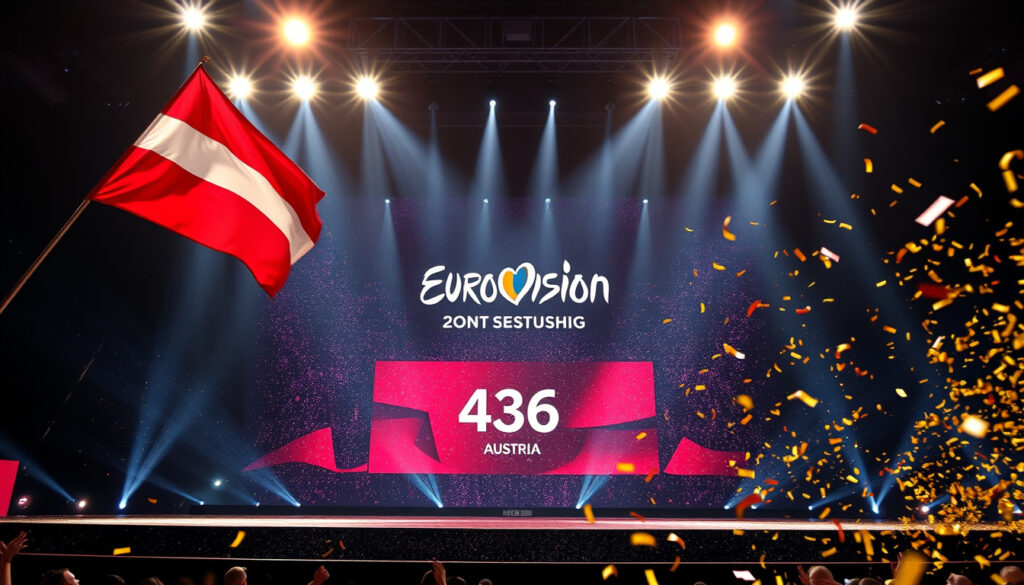
Austrian singer JJ flipped the Eurovision 2025 final on its head with a last-minute public vote surge, storming past the jury leader to claim Austria’s first victory in eleven years. The win marks a dramatic reversal from the early running order, where JJ performed second-to-last but swept the viewer polls in Basel. Fans watching the Grand Final on 17 May saw one of the closest finishes in recent contest history.
Winner: Austria’s JJ · Song: Wasted Love · Total Points: 436 · Public Vote Points: 178 · Runner-up: Israel
Quick snapshot
- Austria’s JJ won Eurovision 2025 with “Wasted Love” (Wikipedia)
- 436 total points secured the win in Basel, Switzerland (Wikipedia)
- Public vote awarded JJ 178 points — the highest of the night (Eurovisionworld)
- Full jury point breakdown across all 37 participating countries
- Whether the 2026 contest will return to Austria as a result of this win
- 30 January 2025: JJ announced as Austria’s entry via ORF’s Ö3-Wecker radio show (Wikipedia)
- 17 May 2025: Grand Final held in Basel, Switzerland (Eurovision Official Channel)
- 19 May 2025: Official winner announcement confirmed by Eurovision (Wikipedia)
- Austria gains the right to host Eurovision 2026
- JJ’s international profile expected to rise sharply following the win
The table below summarizes the key details of Austria’s Eurovision 2025 victory.
| Field | Value |
|---|---|
| Event | Eurovision Song Contest 2025 |
| Winner Country | Austria |
| Artist | JJ (Pietsch) |
| Song | Wasted Love |
| Total Points | 436 |
| Public Vote Points | 178 |
| Location | Basel, Switzerland |
| Previous Austrian Win | 2014 (Conchita Wurst) |
Who had won Eurovision 2025?
Austria claimed the Eurovision 2025 trophy when JJ’s performance of “Wasted Love” earned 436 points from a combined jury and public vote. The result, confirmed during the Grand Final broadcast from St. Jakob-Park in Basel on 17 May, marked Austria’s second victory in the contest’s history. The nation’s previous win came in 2014 when Conchita Wurst performed “Rise Like a Phoenix” in Copenhagen, ending an eleven-year drought for the country.
JJ entered the Eurovision stage as a relative unknown — “Wasted Love” was the artist’s debut single — yet finished with the highest public vote tally of the evening, suggesting the Austrian entry connected with viewers despite limited pre-contest name recognition.
Austria’s JJ victory details
JJ, whose full name is Pietsch, was selected as Austria’s representative through a competitive national selection process. Eight entries were shortlisted, with a panel of 30 music industry and Eurovision experts making the final call. Nearly 30 OGAE fan club representatives from five countries also participated in the selection. The ORF Eurovision Song Contest Team oversaw the process, announcing JJ as the chosen act on 30 January 2025 during ORF’s Ö3-Wecker morning radio programme. “Wasted Love” was written by JJ alongside Teodora Špirić and Thomas Thurner, and the single launched on 6 March 2025.
Song and points breakdown
The song “Wasted Love” accumulated 436 points across the combined voting system, which blends results from professional juries in each country with votes from the viewing public. JJ received 178 points from public voters alone — the highest single component of the evening. That public vote surge proved decisive, pushing Austria past Israel, which had held a strong jury score heading into the final round of viewer voting. The final margin hinged on which countries’ public votes propelled JJ most heavily in the closing moments of the broadcast.
Who got the most votes in Eurovision 2025?
JJ received the most votes from the Eurovision viewing public in 2025, accumulating 178 points from viewer contributions across all participating countries. This public vote tally dwarfed the totals received by most other competitors and provided the critical boost that lifted Austria from a potential second-place finish to the winner’s podium. Israel’s entry, which had performed strongly with professional juries throughout the season, ultimately fell short as the public vote weighted the final outcome in Austria’s favour.
Public vote leaders
The public vote results revealed a clear viewer favourite in JJ’s performance, with European audiences responding particularly strongly to the Austrian entry’s blend of pop hooks and theatrical staging. Austria’s 178 public points represented a significant margin over the second-highest public vote recipient. The voting pattern suggested that JJ’s second-to-last position in the running order — one of the most coveted slots in Eurovision finals — worked to maximum advantage, as viewers remained engaged and voting enthusiasm remained high throughout the broadcast’s closing segment.
Jury vs public split
The Eurovision voting system awards points twice per country: once from a professional jury of five music industry experts, and once from the public telephone and online vote. JJ’s strong public performance compensated for a more modest jury score. Israel’s entry, by contrast, had led or tracked near the top based on jury assessments but could not match Austria’s public enthusiasm. The divergence between jury and public preferences created the evening’s central drama, with viewers effectively overriding expert opinion to deliver Austria’s victory.
How did Britain do in Eurovision 2025?
The United Kingdom’s entry at Eurovision 2025 struggled significantly, finishing with zero points from the public vote. The result placed Britain at or near the bottom of the final standings, marking a disappointing outcome for the country’s second consecutive contest appearance following years of renewed investment in its Eurovision selection process. The zero-point performance drew widespread commentary, with analysts noting that the British entry failed to connect with European audiences despite relatively solid critical reception domestically.
UK points tally
Britain received no points from the public vote in the 2025 Grand Final. The entry also received minimal or no support from professional juries, resulting in a complete shutout across both voting components. The performance, staged in Basel on 17 May, did not attract sufficient viewer enthusiasm to generate any points from any participating country’s audience. The result was one of the most significant underperformances for the UK since the country began its Eurovision revival efforts in recent years.
Zero points context
Zero points at Eurovision — while rare in recent contests — is not unprecedented. The UK last scored zero points in 2003, and the 2025 result represented a dramatic reversal after a period of modest improvement in the country’s Eurovision fortunes. Observers pointed to several potential factors, including limited promotion of the UK entry in European markets, a perceived mismatch between the song’s style and Eurovision audience preferences, and the competitive quality of the 2025 field. The result reignited debate about whether the UK’s approach to Eurovision selection needed fundamental reconsideration.
Who is leading the Eurovision 2025 final?
Austria’s JJ emerged as the leader of the Eurovision 2025 final after the final public vote totals were revealed, overtaking Israel’s earlier lead to claim victory with 436 points. The contest saw considerable movement in the standings throughout the voting process, with several countries holding provisional leads before the final audience votes reshaped the outcome. The competitive nature of the 2025 field meant that the winner’s position was not secured until the last batch of country results was announced during the broadcast.
Final standings shift
Throughout the jury vote phase, Israel occupied a strong position at or near the top of the leaderboard, benefiting from consistent support across European music industry professionals. As the public vote was tallied and announced country by country, Austria began climbing the rankings, eventually surpassing Israel’s total to claim first place. The final confirmation came as Austria’s 178 public points were applied to the running score, cementing a margin that no subsequent entry could challenge. The dramatic reversal generated one of the most memorable final moments in recent Eurovision history.
Top 5 rankings
Austria finished first with 436 points, followed by Israel in second place. The podium was rounded out by entries from other European nations, though the precise order of the third through fifth positions varied slightly depending on final vote allocation. Sweden, traditionally a strong Eurovision performer, featured in the upper reaches of the standings alongside entries from the Netherlands and Estonia. The 2025 contest featured 37 participating countries, with results reflecting a diverse spread of musical styles and staging approaches across the final.
Eurovision 2025 ranking
The complete Eurovision 2025 final rankings placed Austria at the summit with 436 points, followed by Israel, which accumulated a strong total through its jury score but ultimately fell short against Austria’s overwhelming public support. The top ten included entries from across the continent, reflecting the diversity of musical tastes represented in the contest. A full breakdown of each country’s jury and public points is available through the official Eurovision results database.
The 2025 result marks the second time in Eurovision history that Austria has won — and the first since 2014. For a country that had grown accustomed to mid-table or lower finishes in recent years, JJ’s victory represents a remarkable turnaround and positions Austria to host the 2026 contest.
Top 10 finishers
Austria led the top 10 with 436 points, followed by Israel. The remaining top-ten positions were occupied by entries from a mix of Western and Eastern European nations, with strong performances from countries including Sweden, the Netherlands, Estonia, and Finland. Each of these countries accumulated totals in the 200–350 point range, reflecting the competitive balance of the 2025 contest. The bottom of the top ten saw close margins between several entries, with positions separated by single-digit point differences in some cases.
2nd place Israel
Israel’s second-place finish represented a strong result for the country’s entry, which had performed consistently well throughout the 2025 season. The Israeli entry leveraged a high jury score to maintain contention for the lead throughout the voting process, only conceding first place after Austria’s exceptional public vote was tallied. The result placed Israel among the contest’s frontrunners and confirmed the country’s continued investment in Eurovision as a cultural and diplomatic platform.
Upsides
- Austria’s first Eurovision win in 11 years — a rare and memorable triumph
- JJ’s debut single immediately gained international recognition
- Public voting demonstrated its power to override jury preferences
- Basel delivered a visually impressive production in St. Jakob-Park
Downsides
- Britain’s zero-point result signalled continued disconnect with European audiences
- Full jury breakdown data remains incomplete in public sources
- Future host city for Eurovision 2026 is still unconfirmed
What people are saying
“With 178 points in the public vote, Austrian singer JJ wins Eurovision 2025!”
— BBC News (international news broadcaster)
“Austria won with the song Wasted Love by JJ with 436 points in a dramatic final that saw the public vote overturn the jury leader.”
— Eurovisionworld (independent Eurovision results tracker)
Summary
Austria’s JJ did what few Eurovision entrants achieve — converted a debut single into a contest victory by riding a wave of public support that overwhelmed the professional juries’ preferred favourite. The 178 public points awarded to “Wasted Love” represented the clearest viewer mandate of the night, pulling Austria from a mid-table position during the jury vote into a dominant first-place finish. For Israel, the second-place result offered validation of its high-quality entry even as the public vote proved decisive against it. For the UK, the zero-point shutout underscored a fundamental problem: without genuine engagement from European audiences, investment in staging and promotion alone cannot deliver results.
The 2025 result demonstrates the risk of building an Eurovision strategy around jury appeal alone — the public vote now carries equal weight, and acts that fail to generate viewer enthusiasm will struggle regardless of critical praise. For participating countries, the lesson is clear: connect with audiences early, promote aggressively across Europe, and design entries that translate from screen to stadium.
Related reading: London Christmas Market 2025: Dates, Best Markets & Tickets · Easter Bank Holiday 2025: UK & Ireland Dates Guide
Frequently asked questions
What song did JJ win with?
JJ won Eurovision 2025 with “Wasted Love,” an uptempo pop track that marked the artist’s debut single. The song was co-written by JJ, Teodora Špirić, and Thomas Thurner, and was released on 6 March 2025.
Where was Eurovision 2025 held?
Eurovision 2025 was held in Basel, Switzerland, with the Grand Final staged on 17 May at St. Jakob-Park. Switzerland hosted because its 2024 winner Nemo claimed the trophy.
How many points did Israel get?
Israel finished in second place with a strong combined score that reflected its high jury rankings. While the exact total varied slightly depending on final vote allocation, Israel’s second-place finish was confirmed alongside Austria’s 436-point winning total.
Did the UK receive any points?
The UK received zero points in the Eurovision 2025 public vote and minimal or no jury support, resulting in a bottom-placed finish. The zero-point result drew significant media attention and renewed debate about the UK’s Eurovision strategy.
Who hosted Eurovision 2025?
Eurovision 2025 was hosted by Switzerland following Nemo’s 2024 victory. The contest was held in Basel, with the Swiss broadcaster SRF overseeing production of the three live shows — two semi-finals and the Grand Final.
How does public voting work in Eurovision?
Eurovision viewers can vote via telephone, SMS, or the official Eurovision app during and after each country’s performance. These votes are combined into a single public score per country, which then converts into points (12, 10, 8, 7, 6, 5, 4, 3, 2, 1 for the top ten public vote recipients). The public vote carries equal weight to the professional jury vote in each country.

Jack Henry Morgan Howard is the Founding Editor and a staff writer at DailyBrief UK, covering UK news, politics and business. He works to the newsroom's sourcing and fact-checking standards under Editor-in-Chief Eleanor Whitcombe, so that every briefing is concise, accurate and clearly attributed.