
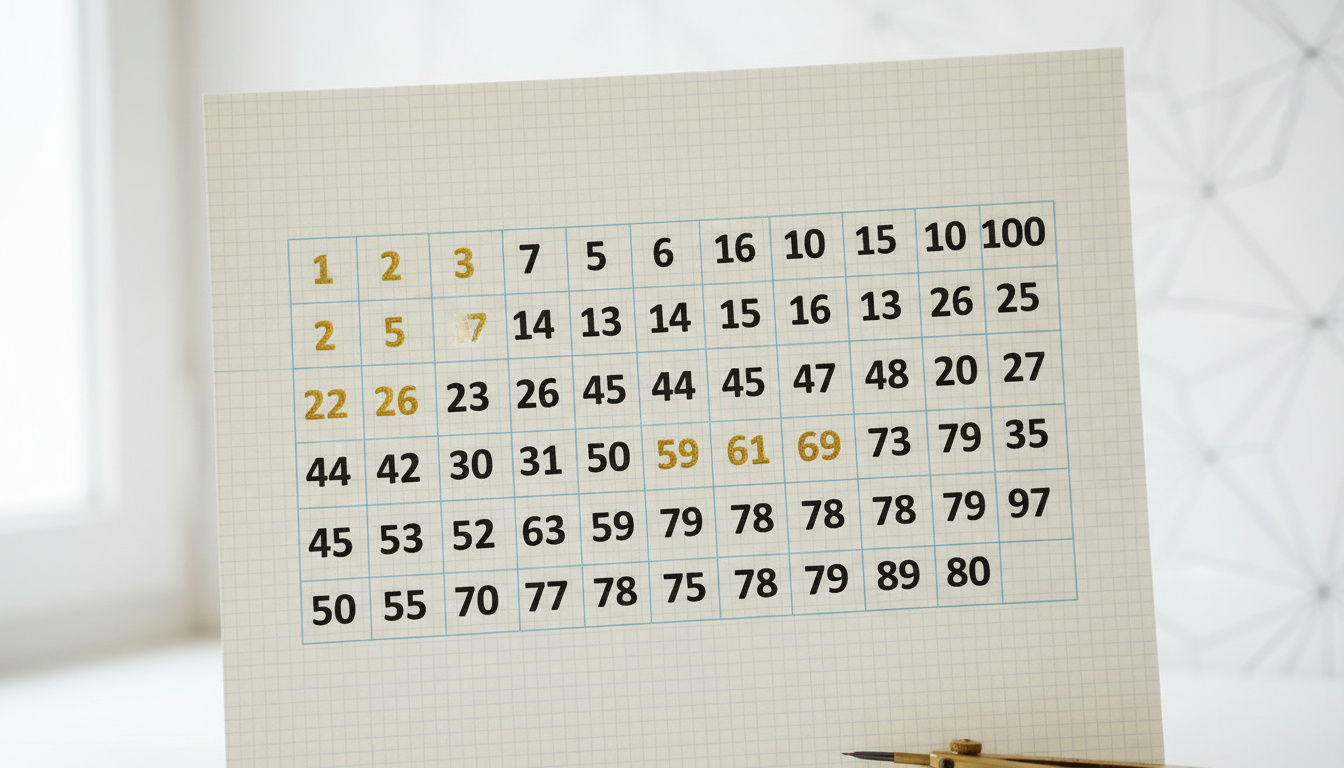

Prime numbers serve as the indivisible building blocks of arithmetic. Between 1 and 100, exactly 25 such numbers exist, ranging from the smallest prime 2 to the largest prime 97. These integers possess a unique mathematical property: each is divisible only by 1 and itself.
Unlike composite numbers, primes cannot be broken down into smaller whole-number factors. This characteristic makes them essential for modern cryptography, random number generation, and fundamental mathematical proofs. Students, educators, and researchers regularly consult prime number charts to verify these values.
What Are the Prime Numbers from 1 to 100?
The complete sequence includes twenty-five distinct integers. These appear scattered throughout the number line with irregular intervals, becoming progressively less frequent as values increase toward 100.
25 primes
1 to 100
2
97
Several patterns emerge when examining these values:
- Unique even status: 2 stands as the only even prime number; all others are odd.
- Decreasing density: The first half of the range (1-50) contains 15 primes, while the second half (51-100) contains only 10.
- Final digit restriction: No primes greater than 5 end in 0, 2, 4, 5, 6, or 8.
- Cryptographic foundation: These numbers underpin encryption algorithms securing digital communications.
- Indivisibility: Each number has exactly two distinct factors: 1 and itself.
- Largest boundary: 97 represents the final prime before the three-digit threshold.
- Sequential position: The 25th prime in mathematical sequence is 97.
The following table presents the complete indexed list:
| Position | Prime | Position | Prime | Position | Prime |
|---|---|---|---|---|---|
| 1 | 2 | 10 | 29 | 19 | 71 |
| 2 | 3 | 11 | 31 | 20 | 73 |
| 3 | 5 | 12 | 37 | 21 | 79 |
| 4 | 7 | 13 | 41 | 22 | 83 |
| 5 | 11 | 14 | 43 | 23 | 89 |
| 6 | 13 | 15 | 47 | 24 | 97 |
| 7 | 17 | 16 | 53 | 25 | – |
| 8 | 19 | 17 | 59 | ||
| 9 | 23 | 18 | 61 |
How Many Prime Numbers Are There from 1 to 100?
Twenty-five. This fixed quantity remains constant across all mathematical contexts, unlike variable counts such as How Many Bank Holidays in 2024, which fluctuates by jurisdiction and calendar year.
The distribution reveals an important mathematical trend: primes thin out as numbers grow larger. In the first fifty integers, primes appear roughly every 3.3 numbers on average. Between 51 and 100, this interval stretches to every 5 numbers.
Ninety-seven marks the upper boundary. No prime exists between 97 and 100, as 98, 99, and 100 all possess multiple factors beyond 1 and themselves.
Is 1 a Prime Number? Definition and Explanation
The Fundamental Definition
A prime number is strictly defined as a whole number greater than 1 that has exactly two distinct factors: 1 and itself. This definition excludes zero and negative integers from consideration. According to Mashup Math and SplashLearn, this two-factor requirement is absolute.
Why 1 Is Excluded
One fails the prime test because it possesses only one factor: itself. The Fundamental Theorem of Arithmetic requires that every integer greater than 1 be represented uniquely as a product of primes. If 1 were prime, this uniqueness would collapse, as numbers could be factized with unlimited instances of 1.
The number 1 is classified as a unit, neither prime nor composite. This exclusion maintains the integrity of prime factorization systems used throughout number theory.
Testbook and Math Equals Love both confirm this exclusion based on the factor count principle.
Prime Numbers Between 1 and 50 and 51 to 100
The First Fifteen (1-50)
The denser cluster appears early: 2, 3, 5, 7, 11, 13, 17, 19, 23, 29, 31, 37, 41, 43, and 47. This grouping includes the only even prime and establishes the pattern of odd-number dominance. The gap between 43 and 47 represents the first span greater than two digits between consecutive primes in this range.
The Final Ten (51-100)
The latter half contains: 53, 59, 61, 67, 71, 73, 79, 83, 89, and 97. These appear with increasing scarcity. Much like tracking One Pound in INR requires watching specific numerical values change, identifying these primes demands attention to precise positions on the number line where no factors exist beyond the trivial pair.
The largest gap between consecutive primes under 100 occurs between 89 and 97, spanning eight integers. This widening interval illustrates the Prime Number Theorem, which predicts decreasing density as values escalate.
How to Find Prime Numbers Up to 100
The Sieve of Eratosthenes provides an ancient yet efficient method for isolating primes. This algorithm, described in detail by MathsIsFun, operates through systematic elimination.
Begin by listing integers 2 through 100. Circle 2 as prime, then eliminate all multiples of 2 (4, 6, 8, etc.). Move to the next uncrossed number, 3, mark it as prime, and eliminate its multiples (6, 9, 12, etc.). Continue this process through 7, the last integer requiring examination since the square root of 100 is 10. All remaining unmarked numbers constitute the 25 primes.
Many beginners continue marking multiples beyond 10. Since any composite number less than 100 must have at least one factor less than or equal to 10, checking primes through 7 suffices for this range.
Visual representations available at EasyCalculation demonstrate this filtering process graphically.
Prime Number Distribution Across the Range
The spacing between consecutive primes reveals irregular but expanding patterns:
- 2 to 3: Gap of 1 (twin primes)
- 3 to 5: Gap of 2
- 47 to 53: Gap of 6 (crossing the 50 threshold)
- 61 to 67: Gap of 6
- 73 to 79: Gap of 6
- 83 to 89: Gap of 6
- 89 to 97: Gap of 8 (widest in range)
This progression demonstrates that while primes exist infinitely, their frequency necessarily decreases as numbers grow larger, consistent with logarithmic distribution models.
Mathematical Certainty: Established Facts vs. Common Misconceptions
| Established Facts | Common Misconceptions |
|---|---|
| Exactly 25 primes exist between 1 and 100 | 1 is often incorrectly identified as prime |
| 2 is the smallest and only even prime | All odd numbers are prime (false: 9, 15, 21, 25, 27, 33, 35, 39, 45, 49, 51, 55, 57, 63, 65, 69, 75, 77, 81, 85, 87, 91, 93, 95, 99 are composite) |
| 97 is the 25th and largest prime under 100 | Prime distribution follows a simple pattern (it is actually quasi-random) |
| Prime factorization is unique for every integer >1 | Zero or negative numbers can be prime (they cannot) |
Why Prime Numbers Matter
These integers function as the multiplicative atoms of mathematics. Every composite number breaks down into a unique product of primes, a concept known as the Fundamental Theorem of Arithmetic.
Modern encryption systems rely on the difficulty of factizing large prime products. When two massive primes multiply, recovering the original factors computationally exceeds practical timeframes. This mathematical asymmetry secures banking transactions, digital signatures, and confidential communications worldwide.
Additional educational resources and visualization charts appear at Math Equals Love.
Sources and Mathematical Authority
Euclid’s Elements established the infinitude of primes over two millennia ago. Contemporary verification confirms the 25 primes below 100 through computational and theoretical means.
“Prime numbers are what is left when you have taken all the patterns away. I think prime numbers are like life. They are very logical but you could never work out the rules, even if you spent all your time thinking about them.”
— Mark Haddon, The Curious Incident of the Dog in the Night-Time
Contemporary educational sources including EasyCalculation, Testbook, and Mashup Math consistently validate the complete list of 25 primes through independent verification.
Key Takeaways
Twenty-five prime numbers populate the range between 1 and 100, beginning with 2 and concluding with 97. These indivisible integers decrease in frequency as values increase, with only ten appearing in the second half of the range. Understanding their distribution and the Sieve of Eratosthenes method provides essential foundation for advanced number theory and practical cryptographic applications.
Frequently Asked Questions
What is the 25th prime number?
Ninety-seven. It is the largest prime number less than 100 and the final entry in the sequence spanning from 1 to 100.
Are there any even primes besides 2?
No. Two is the only even prime number. Any other even number is divisible by 2, giving it at least three factors (1, 2, and itself), which violates the prime definition.
How does the Sieve of Eratosthenes work for 1-100?
List numbers 2 through 100. Eliminate multiples of 2, then 3, then 5, then 7. All remaining unmarked numbers are the 25 primes. You need only check primes up to 7 because the square root of 100 is 10.
Is 1 a prime number?
No. One has only one factor (itself), while primes require exactly two distinct factors: 1 and the number itself.
What is the largest prime number under 100?
Ninety-seven. It appears at position 25 in the sequence of all prime numbers.
How many primes are between 50 and 100?
Ten: 53, 59, 61, 67, 71, 73, 79, 83, 89, and 97.
Why are prime numbers important in cryptography?
Large primes multiplied together create composite numbers that are computationally difficult to factor back into their prime components. This one-way mathematical function secures encryption keys.

Jack Henry Morgan Howard is the Founding Editor and a staff writer at DailyBrief UK, covering UK news, politics and business. He works to the newsroom's sourcing and fact-checking standards under Editor-in-Chief Eleanor Whitcombe, so that every briefing is concise, accurate and clearly attributed.