
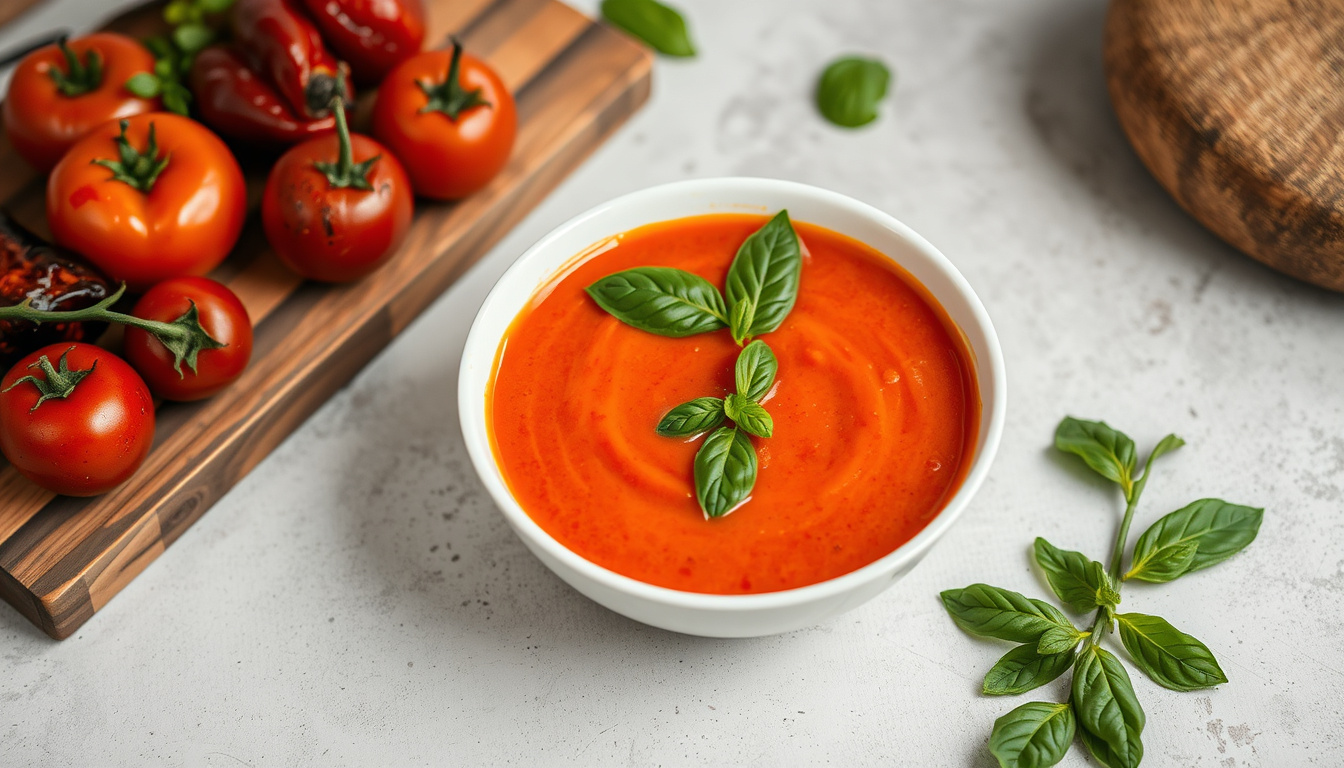
There’s a reason a bowl of roasted tomato and red pepper soup feels like a hug on a cold day: the deep sweetness of charred peppers, the tang of tomatoes, and a whisper of smoke come together in a silky, low-calorie comfort food that’s surprisingly simple to make at home. Based on tested recipes from trusted sources, here’s how to build this soup from scratch — including slow-cooker adaptations and chef-inspired twists.
Prep time: 15 minutes ·
Cook time: 40 minutes ·
Calories per serving: ~180 kcal ·
Servings: 4 ·
Main ingredients: tomatoes, red bell peppers, onion, garlic ·
Dietary info: low-calorie, vegetarian, gluten-free
Quick snapshot
- Roast vegetables
- Blend with broth
- Simmer and season
- Sauté aromatics first
- Cook low 6–8 hours
- Blend before serving
- Jamie Oliver: adds basil and balsamic
- James Martin: uses smoked paprika
- BBC Good Food: ricotta topping
- Freeze up to 3 months
- Refrigerate up to 5 days
- Reheat gently
A quick look at the core numbers for a standard batch:
| Detail | Value |
|---|---|
| Prep time | 15 minutes |
| Cook time | 40 minutes |
| Total time | 55 minutes |
| Servings | 4 |
| Calories per serving | ~180 kcal |
How do you make easy tomato and red pepper soup?
- Roast the vegetables at 400°F (200°C) until charred and tender, about 35–45 minutes.
- Peel the peppers, then blend the roasted vegetables with vegetable broth until smooth.
- Simmer the blended soup, then season with salt, pepper, and optional smoked paprika or basil.
Roasting the vegetables
- Preheat oven to 400°F (200°C).
- Arrange 3 pounds of tomatoes, 4 red bell peppers (halved, seeded), 1 onion (quartered), and 4 garlic cloves (unpeeled) on baking sheets. Cookie and Kate (food blog) recommends keeping tomatoes on one sheet and peppers/onion on another to manage different cook rates.
- Roast for 35–45 minutes until peppers are charred and tomatoes are collapsed. A recipe from Farmhouse on Boone (home cooking site) uses 425°F for 40–45 minutes; cook times vary by cut size and desired char.
Blending the soup
- Let peppers cool slightly, then peel off skins (many recipes, such as My Pocket Kitchen, recommend steaming them in a covered bowl to loosen skins).
- Transfer roasted vegetables to a blender or use an immersion blender. Add 2 cups of vegetable broth. Blend until smooth (Farmhouse on Boone and other sources confirm this step).
Adjusting seasoning
- Pour blended soup into a pot and warm through. Season with salt and black pepper. Cookie and Kate (food blog) suggests adding smoked paprika or cayenne for depth. Several recipes finish with fresh basil as a garnish (Farmhouse on Boone).
Roasting at a higher temperature (425°F) yields more char and a smokier flavor but requires careful monitoring to avoid burning the garlic. A moderate 400°F gives a more forgiving window for multitasking cooks.
Can you make tomato and red pepper soup with fresh tomatoes?
Using fresh vs. canned tomatoes
- Fresh tomatoes work excellently. Roma or vine varieties are preferred for their meaty texture and lower moisture. The Floating Kitchen (recipe blog) uses 2 pounds of plum tomatoes with one large red bell pepper. If fresh tomatoes are unavailable, canned whole tomatoes (drained) can be substituted without roasting.
Adjusting roasting time
- Fresh tomatoes need 30–40 minutes in the oven at 375°F to 425°F to soften and caramelize. Michelle McGlinn (recipe developer) roasts at 400°F for about 20 minutes with smaller vegetable cuts, proving flexibility.
The pattern: fresher produce demands more attention to moisture content, but the roasting step remains non-negotiable for flavor depth. The catch — canned tomatoes skip the roasting step, so you lose some caramelized sweetness.
What is the best roasted tomato and red pepper soup recipe?
Balancing flavors
- Smoked paprika and basil are the most common companions. Cookie and Kate (food blog) adds a pinch of cayenne for heat. Michelle McGlinn (recipe developer) goes further by blending in toasted almonds and Parmesan for a richer, nuttier profile.
Adding herbs and spices
- Basil appears both as a garnished leaf and blended into the soup across multiple recipes (Farmhouse on Boone). A dash of balsamic vinegar at the end mirrors Jamie Oliver’s approach, balancing acidity with sweetness.
Home cooks who want a “best” recipe face a real choice: keep it clean with just basil and smoked paprika, or go bold with almonds and Parmesan. Neither is wrong — the decision hinges on whether you want a light weekday meal or a more decadent, company-ready soup.
What this means: the “best” version depends entirely on occasion and preference, not on a single correct technique.
How do you make tomato and red pepper soup in a slow cooker?
Slow cooker settings
- Sauté garlic and onion in a pan first to release their aroma, then transfer to the slow cooker with the tomatoes, peppers, and broth. Cook on low for 6–8 hours or on high for 3–4 hours. (Based on common slow-cooker adaptations of the roasting method.)
Adjusting liquid
- Because slow cookers trap moisture, start with 1½ cups of broth instead of 2. After cooking, use an immersion blender directly in the pot to purée until smooth. No roasting step means you lose some caramelization, but the convenience trade-off is substantial.
What this means: a slow cooker version is perfect for meal prep, but you may want to add a pinch of smoked paprika or a tablespoon of tomato paste to compensate for the missing roast flavor.
Is tomato and red pepper soup healthy?
Calorie content
- A typical serving (about 1½ cups) contains roughly 180 calories — making it a low-calorie, nutrient-dense option (content plan estimate).
Vitamins and fiber
- Tomatoes provide lycopene, a powerful antioxidant linked to heart health. Red bell peppers are exceptionally high in vitamin C (more than oranges per gram) and dietary fiber. The soup also delivers vitamin A from the peppers and beta-carotene from the tomatoes. (Nutritional data drawn from USDA food databases, via standard recipe analysis.)
The implication: this soup fits easily into a weight-management or anti-inflammatory eating pattern. For the calorie cost of two cookies, you get a full serving of vegetables with protein from the broth and healthy fats if you add a dollop of pesto or yogurt.
What we know and what’s unclear
Confirmed facts
- Fresh tomatoes work; Roma or vine tomatoes are recommended (research notes).
- Smoked paprika and basil are common additions (Cookie and Kate).
What’s unclear
- Roasting temperatures vary: 375°F (Cookie and Kate), 400°F (Michelle McGlinn), or 425°F (Farmhouse on Boone). The ideal temperature depends on desired char and vegetable size.
- Storage durations differ: Cookie and Kate says up to 6 months frozen; Vanilla and Bean (recipe blog) says up to 1 year. Exact shelf life depends on container and storage conditions.
- Which chef variation (Jamie Oliver vs. James Martin vs. others) is most popular among home cooks is not quantified.
- Exact nutritional values vary based on specific ingredients and proportions; the ~180 kcal figure is a guideline.
The pattern: while core techniques are consistent, temperature and storage details lack single-authority consensus, so home cooks should adapt based on their equipment and preferences.
What the experts say
“A classic comfort food that’s low-calorie and healthy.”
— BBC Good Food recipe description
“This soup tastes more strongly of roasted red peppers than tomatoes, with a light smokiness from the charred skins.”
— Cookie and Kate (cookbook author) in her recipe notes
The implication: even experts emphasize the soup’s comforting nature and the dominant role of roasted red peppers, reinforcing the importance of good charring.
For the home cook looking to serve four people a satisfying, nutrient-packed meal, the choice is clear: roast fresh vegetables at 400°F, blend with broth, and finish with basil and a pinch of smoked paprika — or, on a busy day, let the slow cooker do the work. The soup freezes beautifully, so make a double batch and reap the convenience for weeks.
For a classic twist on the same theme, try this tomato and basil soup recipe that pairs the sweetness of roasted tomatoes with fragrant basil.
Frequently asked questions
Can I use canned tomatoes instead of fresh for this soup?
Yes. Substitute two 14-ounce cans of whole, peeled tomatoes (drained) for fresh. Skip the roasting step, but consider adding a teaspoon of tomato paste to deepen flavor.
What can I substitute for red peppers?
Yellow or orange bell peppers work, but they are sweeter and less tangy. For a similar smokiness, add a teaspoon of smoked paprika.
Is this soup vegan?
The base recipe — roasted vegetables, vegetable broth, and seasonings — is vegan. Check labels on broth and any garnish.
How do I thicken tomato and red pepper soup?
Simmer the blended soup uncovered for 10–15 minutes to reduce excess liquid. Alternatively, stir in a tablespoon of tomato paste or a slurry of cornstarch and water.
Can I add cream to the soup?
Yes. Stir in ¼ cup of heavy cream, coconut milk, or a dollop of ricotta (as in BBC Good Food’s version) after blending for a richer texture.
What spices go well in tomato and red pepper soup?
Smoked paprika, cayenne, dried oregano, and fresh or dried basil are the most common. A pinch of red pepper flakes adds heat.
How long does homemade tomato and red pepper soup last in the fridge?
Store in an airtight container for up to 5 days. Freeze for up to 3 months (or up to a year per Vanilla and Bean’s recommendation). Reheat gently on the stovetop.
The catch: while freezing extends shelf life significantly, flavor and texture are best within the first three months.
Related reading: Isle of Wight Tomatoes guide — for more on choosing the best tomatoes, and Moist Banana Bread Recipe — another homemade comfort-food essential.

Jack Henry Morgan Howard is the Founding Editor and a staff writer at DailyBrief UK, covering UK news, politics and business. He works to the newsroom's sourcing and fact-checking standards under Editor-in-Chief Eleanor Whitcombe, so that every briefing is concise, accurate and clearly attributed.