
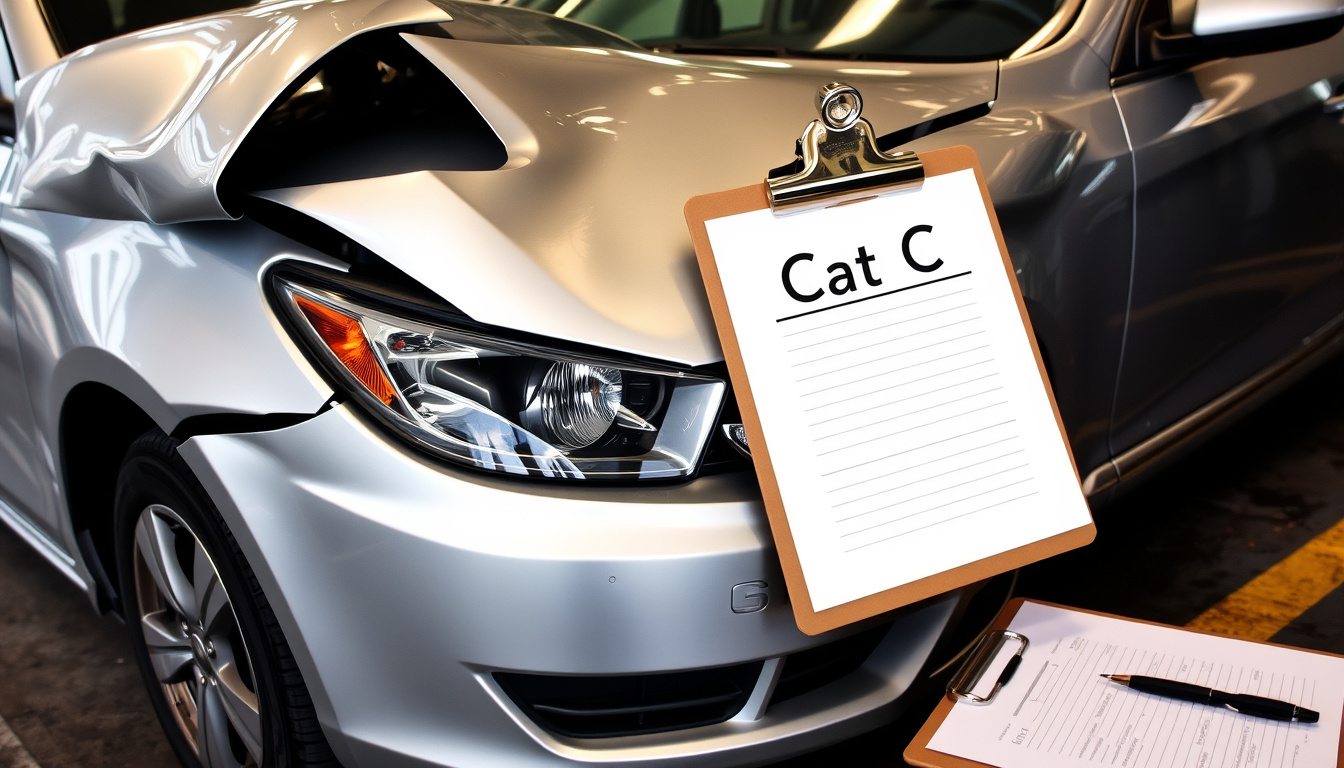

If you’ve spotted a used car listed at a suspiciously low price, there’s a good chance it’s a Category C write-off. This guide explains exactly what a Cat C car means, how it compares to other write-off categories, and what you need to consider before buying one.
Definition: Repair costs exceed pre-accident value · Origin: Assigned by insurance companies (ABI classification) · Repairability: Vehicle is repairable but cost exceeds value · Insurance impact: Affects premiums and future coverage options
Quick snapshot
- Cat C repair costs exceed pre-accident value (Cartell.ie (Irish vehicle data provider))
- Vehicle can be returned to road after proper repair (RAC Drive (UK motoring organisation))
- Whether buying a Cat C car is financially worthwhile depends on individual repair quotes and intended use
- Long-term insurance availability may vary by provider
- UK insurers replaced Cat C with Cat S (structural damage) in October 2017 (Cartell.ie)
- Ireland still uses legacy Cat C/D categories for domestic claims, but imports may carry new UK labels
The table below summarises the key attributes of a Category C write-off.
| Attribute | Value |
|---|---|
| Full name | Category C write-off (insurance classification) |
| Used in | United Kingdom and Ireland |
| Governing body | Association of British Insurers (ABI) |
| Legal status | Vehicle can be registered and driven after repair and inspection |
| Common misconception | Often confused with driving licence category C |
| Repair cost threshold | Exceeds pre-accident value including VAT (Cartell.ie) |
| Post-2017 UK equivalent | Cat S (structural damage) (RAC Drive) |
| Typical resale discount | About 20% less than clean equivalent (MyVehicle.ie) |
| Required certification (Ireland) | Engineer’s report before insurance (MyVehicle.ie) |
What does a Cat C mean on a car?
How insurance companies classify total losses
- Category C means the vehicle is repairable but the total repair cost (including VAT) exceeds its pre-accident value (PAV), making it an economic total loss (Cartell.ie).
- Once an insurer declares a car Cat C, they take ownership of the salvage and sell it — often to a salvage dealer who may repair it or strip it for parts (RAC Drive).
- The car can be returned to the road after a proper repair and, in the UK, a Vehicle Identity Check (VIC); in Ireland, a professional engineer’s report is required (MyVehicle.ie).
Difference between Cat C and other write-off categories
Five main categories exist, ranging from complete destruction (Cat A) to minor damage (Cat D or Cat N). Five categories, one key pattern: the more severe the structural or economic damage, the stricter the rules for returning the car to the road.
| Category | Damage level | Can return to road? | Notes |
|---|---|---|---|
| Cat A | Total destruction | No – must be scrapped | No parts sold except scrap (Cartell.ie) |
| Cat B | Severe damage | No – body shell destroyed | Some mechanical parts may be reused (RAC Drive) |
| Cat C | Significant/serious | Yes after repair | Repair costs exceed PAV (Cartell.ie) |
| Cat D | Minor damage | Yes after repair | Repair costs less than PAV (Cartell.ie) |
| Cat N (post-2017 UK) | Non-structural damage | Yes after repair | Replaced Cat D; no structural issues (RAC Drive) |
| Cat S (post-2017 UK) | Structural damage | Yes after repair | Replaced Cat C; structural repair needed (RAC Drive) |
The implication: Cat C sits in the middle — repairable but expensive to fix. Buyers should not confuse it with Cat A/B (which are death sentences for the car) or Cat D (which is typically cheaper and easier to repair).
Is cat C better than cat D?
Cat C vs Cat D: repair cost thresholds
Cat C and Cat D are both repairable, but the threshold differs. For Cat C, repair costs exceed the car’s pre-accident value; for Cat D, the repair bill is lower than the value — so the write-off often results from other factors like courtesy car costs (Cartell.ie). The catch: Cat C cars usually have more extensive damage than Cat D, though not necessarily structural.
A Cat D car typically costs less to repair and carries a smaller hit to insurance premiums and resale value than a Cat C. But a well-repaired Cat C can still be a safe, usable car if the buyer does their homework.
Which category is worse for resale value
Cat C cars lose about 20% of value compared to a clean equivalent (MyVehicle.ie). Cat D vehicles also depreciate, but the hit is generally smaller. Data from Irish vehicle check services shows that the resale discount for Cat D is typically 10–15% (estimated). The implication: if you plan to sell within a few years, a Cat C may be the worse financial bet.
Should I buy a Category C car?
Pros and cons of buying a Cat C vehicle
Upsides
- Lower purchase price — often 20–30% below market value
- Opportunity for mechanically minded buyers to repair and save money (MyVehicle.ie)
- Some Cat C cars have only cosmetic damage from floods or minor collisions
Downsides
- Reduced resale value (about 20% less) (MyVehicle.ie)
- Higher insurance premiums — some insurers refuse cover entirely
- Potential hidden structural or safety issues if repairs were substandard (RAC Drive)
- Requires an engineer’s report in Ireland before insurance (MyVehicle.ie)
Important checks before purchasing a Cat C car
- Obtain a full vehicle history check — services like Cartell or MyVehicle can reveal the write-off status and any outstanding finance (MyVehicle.ie)
- Get a professional pre-purchase inspection from a qualified mechanic independent of the seller (RAC Drive)
- Check repair receipts and ensure all work was done by a reputable garage
- Contact your insurer to confirm they will cover a Cat C write-off before you buy
The pattern: due diligence is non-negotiable. A Cat C car that was professionally repaired with genuine parts can be a bargain; one that was patched up can be a money pit.
Does Cat C affect insurance?
How being a Cat C write-off impacts insurance premiums
Yes, and the effect is almost always negative. Insurers view a Cat C car as a higher risk because its repair history is uncertain and its structural integrity may be compromised. Premiums for Cat C cars are generally higher, and some insurers will not provide comprehensive cover (MyVehicle.ie).
Can you get comprehensive insurance for a Cat C car?
Yes, but you must disclose the write-off status honestly. Specialist insurers exist who cover repaired write-offs, often requesting photographic evidence and a structural engineer’s report (MyVehicle.ie). Failure to disclose can lead to policy cancellation.
Even if you find cover, the premium may be 20–40% higher than for a clean car. Factor this into your total ownership cost — the saving on the purchase price can be eaten by extra insurance costs over 2–3 years.
The catch: insurance costs can offset the initial savings, so calculate total cost of ownership before committing.
What does C allow you to drive?
Driving licence category C: vehicles over 3.5 tonnes
This is a common point of confusion. Category C on a driving licence refers to vehicles over 3.5 tonnes — typically lorries and large vans. To obtain a Cat C licence you must pass a medical and a separate driving test. This classification has nothing to do with insurance write-off categories.
How to obtain and renew a Cat C licence
- Applicants must be at least 18 years old and hold a full car licence (Category B) (UK Government (DVLA guidance))
- Requires a Driver Certificate of Professional Competence (CPC) for professional drivers
- Medical checks are needed every 5 years from age 45, annually from 65
Why this matters: if you search for “cat c car meaning” and find licence-related results, you’re looking at a different topic entirely. Always check the context.
Comparison table: Category C vs all write-off categories
Six categories exist across UK and Irish systems. Six categories, one decisive factor: whether the car can ever legally return to the road.
| Category | Road legal after repair? | Resale value impact | Insurance complexity |
|---|---|---|---|
| Cat A | No | Scrap value only | N/A |
| Cat B | No | Parts value only | N/A |
| Cat C | Yes | ~20% less (MyVehicle.ie) | Higher premiums, some refuse cover (MyVehicle.ie) |
| Cat D | Yes | ~10–15% less | Moderate increase |
| Cat N (post-2017) | Yes | ~10–15% less (RAC Drive) | Lower than Cat S |
| Cat S (post-2017) | Yes | ~20% less (RAC Drive) | Higher than Cat N |
The pattern: road legality is the decisive factor. Only Cat A and B are permanently banned; all others can be driven after compliant repairs.
Clarity: what’s certain and what’s not
Confirmed facts
- Cat C definition: repair costs exceed pre-accident value (Cartell.ie)
- Cat C vehicles are repairable and can be re-registered after inspection (RAC Drive)
- Insurance premiums for Cat C cars are generally higher (MyVehicle.ie)
What’s unclear
- Whether buying a Cat C car is financially worthwhile depends on individual repair quotes, intended use, and the quality of the repair
- Long-term insurance availability may vary by provider — some may drop cover after a year
- The exact resale discount for a Cat C in Ireland vs. UK is not well documented; 20% is a typical estimate
These uncertainties mean you must verify every detail with professionals before buying.
Expert perspectives
Category C – The vehicle is repairable; however, the repair costs exceed the pre-accident value of the vehicle.
– RSA (Road Safety Authority, Ireland)
A Cat C classification is applied when a vehicle has been seriously damaged and the cost of the repair is deemed greater than its market value.
– RAC Drive (UK motoring organisation) (source)
What these two regulators agree on: the economic threshold is the defining factor. Neither says Cat C cars are unsafe — only that the maths doesn’t add up for the insurer.
Summary
A Category C write-off is not a death sentence for a car — it can be safely returned to the road — but it carries real financial and practical consequences. For the Irish buyer, the choice is clear: invest in a professional inspection and an engineer’s report, or risk buying a car that costs more in repairs and insurance than you saved on the sticker price.
Frequently asked questions
Can I drive a Cat C car immediately after buying it?
No. The car must be repaired, inspected, and registered. In Ireland, you need an engineer’s report before you can insure it. In the UK, a Vehicle Identity Check (VIC) is required.
Is Cat C the same classification in Ireland and the UK?
Historically yes, but since October 2017 the UK replaced Cat C with Cat S (structural damage). Ireland still uses Cat C for domestic claims, but imported UK vehicles may have the new labels.
Do I have to declare a Cat C write-off when selling the car?
Yes. In both Ireland and the UK, it is a legal requirement to disclose a known write-off history to a buyer. Failing to do so can lead to claims of misrepresentation.
What documents come with a Cat C car?
A properly repaired Cat C car should come with a full repair invoice, a Vehicle Identity Check certificate (UK) or engineer’s report (Ireland), and the original V5C logbook showing the write-off marker.
How much cheaper is a Cat C car compared to a non-write-off?
Typically 20–30% cheaper than a clean equivalent, but this varies by age, model, and damage extent (MyVehicle.ie).
Can a Cat C car be exported to another country?
Yes, but the importing country may reclassify the vehicle. Check local regulations before buying a Cat C for export.
Does a Cat C write-off affect the vehicle’s MOT (roadworthiness test)?
No — if the car is properly repaired, it should pass an MOT. The write-off status does not itself cause a failure, but poor repairs may.
Related on DailyBrief
- Cast of Coronation Street: Current, New & Former Actors (2025)
- Cast of Outer Banks: Complete List of Actors by Season
- Richest Woman in the World 2026: Alice Walton Tops List
- Pixel 10 Pro XL Review: Size, Price, Battery Life & Worth Buying
More from Blog on DailyBrief.

Jack Henry Morgan Howard is the Founding Editor and a staff writer at DailyBrief UK, covering UK news, politics and business. He works to the newsroom's sourcing and fact-checking standards under Editor-in-Chief Eleanor Whitcombe, so that every briefing is concise, accurate and clearly attributed.