

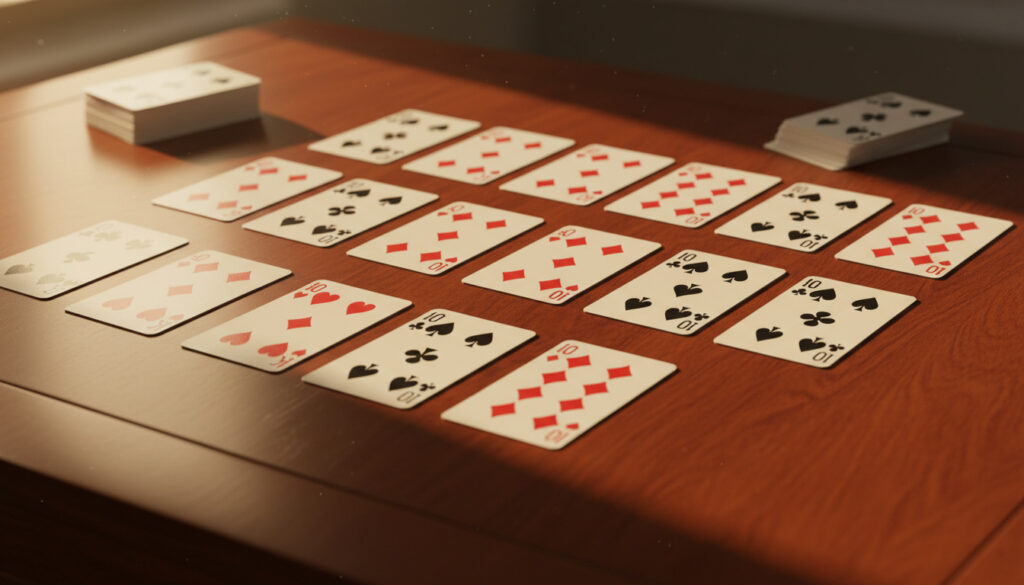
Spider Solitaire 4 Suits stands as the most demanding variant of the classic patience game, challenging players to organize two complete decks into eight perfect sequences. The game requires building descending runs from King to Ace within single suits, testing strategic depth beyond simpler single-color versions.
Each deal presents 104 cards across ten tableau columns, with fifty cards held in reserve. Success demands careful management of mixed-suit stacks and precise timing of stock deals.
How Do You Play Spider Solitaire 4 Suits?
- Only same-suit sequences move as units; mixed suits block mobility
- Empty columns serve as critical temporary storage
- Stock deals bury existing cards, requiring careful timing
- Exposing face-down cards early expands available moves
- Complete sequences auto-clear to foundations
- Online versions allow unlimited undo for practice
- 2-Suit variant offers intermediate practice
| Aspect | Details |
|---|---|
| Total Cards | 104 (two standard decks) |
| Tableau Columns | 10 |
| Initial Deal | 54 cards (columns 1-4: 6 cards; 5-10: 5 cards) |
| Stock Pile | 50 cards |
| Foundation Goal | 8 complete suits (King to Ace) |
| Moveable Units | Single cards or same-suit descending sequences |
| Empty Column Use | Any card or sequence |
| Win Rate | Approximately 8% |
| Difficulty Class | Advanced/Expert |
| Auto-Clear | Complete sequences remove automatically |
The layout distributes six cards to the first four columns and five to the remaining six, with only the top card face-up in each. BVS Solitaire confirms this 54-card opening formation leaves fifty cards for the stock pile. 4 Suits Solitaire Layout and Tactics provides additional visual breakdowns of this setup.
Is Spider Solitaire 4 Suits Hard? Difficulty Explained
The four-suit variant presents a significant complexity increase over its two-suit counterpart. Managing four distinct suits instead of two creates exponentially more mixed-suit combinations that restrict movement.
Why Four Suits Changes Everything
Random deals frequently interleave hearts, diamonds, clubs, and spades across columns. Without early same-suit consolidation, players encounter immovable stacks where cards of different suits block each other. Solitaire Bliss data indicates an approximate 8% win rate, reflecting the narrow margin for error.
Comparing 2 Suits vs 4 Suits
Two-suit Spider uses the same 104-card volume but limits suits to two colors, typically hearts and spades. This reduction allows sequences to match more frequently, raising win rates significantly above the four-suit baseline. 247 Solitaire notes that intermediate players often train on two-suit versions before attempting the full challenge.
Most platforms recommend mastering 1-Suit, then 2-Suits, before attempting 4-Suits. The skill transfer is direct, but the strategic tolerance for mixed suits drops dramatically in the full variant.
Best Strategies and Tips to Win Spider Solitaire 4 Suits
Victory requires prioritizing same-suit builds from the opening moves. Natural sequences provide the only method to move multiple cards simultaneously, creating the space needed to expose buried cards.
Building Natural Sequences
Focus initial moves on connecting cards of identical suits in descending order. A King of hearts descending through Queen, Jack, and Ten of hearts moves as one unit. Mixed-suit stacks of King-Queen (hearts-diamonds) trap cards until separated.
Only descending sequences built entirely within one suit can be moved as a single unit. Mixed-suit stacks must be dismantled individually, severely limiting mobility.
Managing Empty Columns
Clearing a column creates a temporary workspace. Place any card or same-suit sequence here to rearrange the tableau. Strategic guides recommend targeting one empty column early to enable complex card transfers.
Vacant columns function as temporary storage spaces. Place any card or same-suit sequence here to rearrange the tableau and expose buried cards.
Stock Management
The fifty-card stock deals ten cards at a time, one atop each column. This action buries existing cards and should remain a last resort. Delaying stock access preserves tableau flexibility.
Dealing from the stock places one card atop each column, potentially burying critical cards needed to complete sequences. Reserve this action for when no tableau moves remain.
Additional tactics include exposing hidden cards rapidly, building on higher ranks first for flexibility, and temporarily retaining completed suits to untangle mixed stacks beneath them. Advanced players suggest avoiding immediate auto-clearance when underlying cards need rearrangement.
How to Play Spider Solitaire 4 Suits Online for Free
Numerous platforms host browser-based versions requiring no download. Solitaire Bliss and 247 Solitaire offer interfaces with unlimited undo functions and hint systems.
Digital Advantages
Online implementations automate foundation clearing and validate moves instantly. Undo features allow experimentation with risky sequences without penalty, accelerating skill development.
Scoring Mechanics
Scoring varies by platform. Most award 50 points per completed suit, totaling 400 for a full win. Bonuses may apply for move efficiency or completion speed, though specific algorithms differ across sites.
The History of Spider Solitaire 4 Suits
- : Microsoft Windows inclusion popularizes variant globally (Microsoft)
- : Digital standardization establishes consistent rules across platforms
- : Mobile adaptations introduce touch controls and undo features
- : Statistical tracking reveals ~8% baseline win rates (Solitaire Bliss)
Established Rules vs. Uncertain Factors
| Established Facts | Uncertain or Variable Information |
|---|---|
| 104 cards across 10 columns | Exact win rates vary by player skill (8-30% reported) |
| 8 foundations required to win | Specific scoring algorithms differ by platform |
| Same-suit sequences auto-clear | Historical origins pre-1990s lack definitive documentation (Wikipedia) |
| Stock deals 10 cards when activated | Optimal strategy sequences remain debated |
The Appeal of Four-Suit Complexity
The variant endures as the definitive test of solitaire skill. Unlike games dependent on pure chance, four-suit Spider rewards pattern recognition and long-term sequencing. The low win rate creates a psychological challenge where each victory represents genuine strategic mastery.
Digital platforms have preserved this difficulty while removing physical setup constraints. The result maintains the original cognitive demands while allowing infinite retry attempts.
Expert Strategy Perspectives
Prioritize same-suit descending sequences for mobility, as only these move as groups; mix-suit builds limit options.
Expose hidden cards first to uncover face-downs quickly for more moves; hidden cards block progress in 104-card deals.
— 247 Solitaire
Mastering Spider Solitaire 4 Suits
Spider Solitaire 4 Suits demands rigorous attention to suit purity and spatial management. Success requires building natural sequences early, conserving empty columns, and delaying stock deals until absolutely necessary. While the approximately 8% win rate reflects genuine difficulty, systematic application of these principles converts an impossible-seeming layout into a solvable puzzle. Players seeking structured guidance can review How to Play Spider Solitaire 4 Suits for foundational rules.
Can I move partial sequences in Spider Solitaire 4 Suits?
Only sequences built entirely within one suit move as units. Mixed-suit stacks must be moved one card at a time.
What is the best opening move?
Reveal face-down cards immediately by making any available move that exposes hidden cards, prioritizing same-suit connections when possible.
Are jokers used in Spider Solitaire?
Standard Spider Solitaire 4 Suits uses two 52-card decks without jokers, totaling 104 cards.
Why can’t I move certain cards?
Cards remain immobile when buried under other cards or when part of a mixed-suit sequence that hasn’t been separated.
How do scoring bonuses work?
Platforms typically award 50 points per completed suit, with potential bonuses for efficiency, though specific calculations vary by site.
Is there a time limit?
Casual online play usually imposes no time restrictions, though some competitive variants may track completion speed.
How does 4 Suits differ from Klondike?
Spider uses 104 cards and requires building within suits, while Klondike uses 52 cards with alternating colors and separate foundation building.

Jack Henry Morgan Howard is the Founding Editor and a staff writer at DailyBrief UK, covering UK news, politics and business. He works to the newsroom's sourcing and fact-checking standards under Editor-in-Chief Eleanor Whitcombe, so that every briefing is concise, accurate and clearly attributed.