

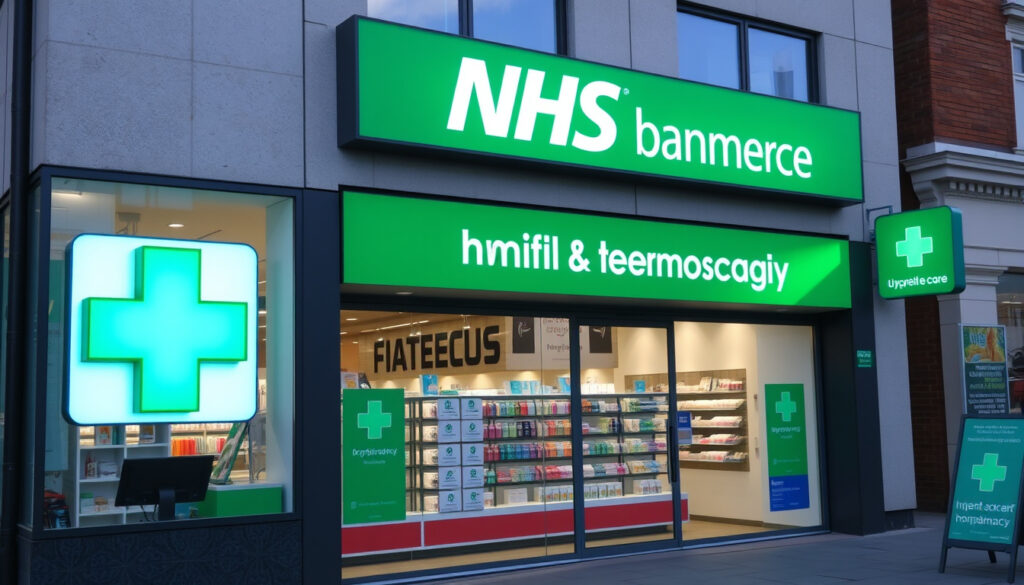
If you’ve woken up with a raging sore throat or felt that tell-tale burn when you pee, the idea of waiting days for a GP appointment can feel impossible. That’s exactly the problem the NHS Pharmacy First service is designed to solve.
Conditions covered: 7 ·
Participating pharmacies in England: 90%+ of community pharmacies ·
Cost to patient (NHS): Free ·
Typical consultation time: Under 15 minutes
Quick snapshot
- Pharmacy First launched in England on 31 January 2024 (NHS England (national health service body))
- Covers 7 specific conditions with clinical criteria (NHS England)
- Free at the point of use for patients (Community Pharmacy England (professional body))
- Exact percentage of participating pharmacies not centrally published
- Long-term impact on GP waiting times and antibiotic resistance still under study
- Future expansion to Wales or to additional conditions remains uncertain
- Scotland launched a similar service in 2023, Northern Ireland in 2021 (NHS England)
- England’s Pharmacy First went live on 31 January 2024 (NHS England)
- Expansion to more conditions possible if pilot data supports it (Community Pharmacy England)
- Online video consultations already offered by some pharmacies (Community Pharmacy England)
Five key facts, one pattern: the service is designed to be quick and free, but eligibility depends on meeting strict clinical criteria.
The table below summarises the core service parameters.
| Label | Value |
|---|---|
| Service name | Pharmacy First (NHS) |
| Available in | England, Scotland, Northern Ireland |
| Conditions treated | 7 |
| Patient cost | Free (NHS) |
| Consultation type | In-pharmacy, no appointment needed |
What can the Pharmacy First scheme do for me?
Who can use the service?
- Anyone registered with an NHS GP in England, Scotland, or Northern Ireland can use Pharmacy First — no GP referral is needed (NHS England guidance).
- Children are covered for specific conditions with age limits (e.g., earache from age 1, sore throat from age 5) (NHS England clinical pathways).
What types of advice are provided?
- Pharmacists offer advice, over-the-counter remedies, and where appropriate, prescription-only medicines including antibiotics (Community Pharmacy England FAQ (pharmacy sector regulator)).
- Consultations take place in a private room; some pharmacies also offer video consultations (Community Pharmacy England).
How long does a consultation take?
- Typically under 15 minutes — far quicker than waiting for a GP appointment.
- If a prescription is needed, the pharmacist can issue it and supply the medicine immediately.
The implication: for anyone with a condition on the list, Pharmacy First effectively eliminates the multi-day wait that often forces people to either suffer or visit A&E.
What are the 7 conditions for Pharmacy First?
Urinary tract infections (UTIs)
- Uncomplicated UTIs in women aged 16 to 64 (NHS England).
- Warning signs assessed include fever, flank pain, and confusion (red flags for referral).
Sore throat
- Applies to people aged 5 and over (NHS England).
- Centor criteria used to determine antibiotic need.
Earache (acute otitis media)
- Ages 1 to 17 years (NHS England).
Sinusitis
- Ages 12 and over (NHS England).
Bites and stings (infected insect bites)
- Ages 1 year and over (NHS England).
Impetigo
- Ages 1 year and over (NHS England).
Shingles
- Adults aged 18 and over (NHS England).
If you fall outside the age bands or have additional symptoms (e.g., fever, vomiting), you’ll be referred to a GP. The pharmacist follows strict protocols — they can’t bend the rules.
The pattern: each condition has precise age and severity limits that determine whether the pharmacist can treat or must refer. That’s the trade-off for fast access without a GP.
Can you go to any Pharmacy First?
Do I need to register?
- No registration required. You can walk into any participating pharmacy (NHS England).
- No appointment needed — just turn up during opening hours.
Can I use any pharmacy offering the service?
- Over 90% of community pharmacies in England are estimated to participate, though an exact central list isn’t published (Community Pharmacy England FAQ).
- Use the NHS pharmacy finder to locate a participating pharmacy near you.
Are there any restrictions based on location?
- The service is available in England, Scotland, and Northern Ireland but not yet in Wales.
- Each nation has its own variant (e.g., Scotland’s NHS Pharmacy First Scotland launched in 2023).
Why this matters: the barrier is low — no forms, no logins — but you need to check your local pharmacy actually offers the service before you walk in.
Can a pharmacist give you antibiotics without seeing a doctor?
Can Pharmacy First treat UTI?
- Yes — uncomplicated UTIs in women 16–64 are a core condition (NHS England).
- The pharmacist will use a clinical pathway to assess symptoms and may prescribe antibiotics (e.g., nitrofurantoin).
Can I get antibiotics for UTI without seeing GP?
- Yes, if you pass the pathway’s gateway criteria (Community Pharmacy England FAQ).
- Self-referral walk-ins are accepted — no need for a GP referral first.
What are the 5 warning signs of UTI?
- Red flags that trigger GP referral include fever (≥38°C), flank pain, vomiting, confusion (in elderly), and visible blood in urine (NHS England clinical guidance).
Antibiotics are only supplied when the pharmacist’s clinical assessment confirms a bacterial infection. Many sore throats and sinusitis cases are viral — you’ll get advice, not a prescription.
The trade-off: you can get antibiotics without a GP, but only if you meet strict clinical criteria. That’s good medicine, not a free-for-all.
Does Pharmacy First cost money?
Is it free on the NHS?
- The consultation itself is free for all patients.
- If a prescription medicine is supplied, standard NHS prescription charges apply in England (£9.90 per item in 2024) unless you are exempt (Community Pharmacy England).
Are there any charges for prescriptions?
- Yes in England for those who pay for NHS prescriptions. In Scotland and Northern Ireland, prescriptions are free for all (Community Pharmacy England FAQ).
What about patients in Scotland or Northern Ireland?
- Both nations offer free prescriptions, so the entire Pharmacy First consultation and any prescribed medicines are free at the point of use.
The implication: in England, the service is still cheaper than a private GP visit, but you may need to pay for the medicine if you’re not exempt.
Upsides
- No appointment needed — walk in and get seen
- Free consultation — zero upfront cost
- Faster than GP — average under 15 minutes
- Pharmacist can prescribe antibiotics for eligible conditions
- Reduces pressure on GP surgeries
Downsides
- Only 7 conditions covered — many common issues excluded
- Strict age limits and clinical criteria
- Prescription charges may apply in England
- Not all pharmacies participate (though most do)
- Not available in Wales
How to use Pharmacy First near you
Step 1: Check your condition
- Confirm your condition is one of the 7 listed above and that you meet the age criteria.
Step 2: Find a participating pharmacy
- Use the NHS online pharmacy finder or call your local pharmacy to ask if they offer Pharmacy First.
Step 3: Walk in or contact them
- No appointment needed. You can also be referred by NHS 111 or your GP surgery (NHS England).
Step 4: Private consultation
- The pharmacist will assess your symptoms in a private room and decide on treatment or referral.
Step 5: Receive treatment or referral
- You may get over-the-counter advice, a prescription medicine, or a referral to your GP if needed.
Clarity: what’s confirmed and what’s unclear
Confirmed facts
- Pharmacy First is live in England (January 2024), Scotland (2023), and Northern Ireland (2021).
- The service covers 7 conditions as listed by NHS England.
- Consultations are free to patients at the point of use.
- Pharmacists can prescribe antibiotics for eligible conditions.
What’s unclear
- Exact number of participating pharmacies is not centrally published; estimates suggest over 90% in England.
- Future expansion to additional conditions or to Wales is speculative.
- Long-term impact on GP waiting times and antibiotic resistance is still being studied.
“Patients will be able to get treatment for seven common conditions directly from their local pharmacy without needing a GP appointment.”
— NHS England press release (January 2024) (NHS England)
“The scheme allowed me to get antibiotics for my UTI on the same day — far quicker than waiting for a GP.”
— Patient feedback compiled by Healthwatch Kingston
For patients in England, the choice is clear: use the Pharmacy First service to bypass GP delays, but always check your condition is covered and that you meet the age criteria. Otherwise you’ll be referred back to your GP anyway.
Patients looking for quick treatment can use the UK-wide NHS Pharmacy First scheme to access care for common conditions without a GP appointment.
Frequently asked questions
Is Pharmacy First available in Wales?
No, not yet. The service is live in England, Scotland, and Northern Ireland. Wales has not announced a launch date.
What if my condition is not on the list?
You’ll be advised to see a GP or visit a minor injuries unit. The pharmacist cannot treat conditions outside the 7 clinical pathways.
Can I get a repeat prescription through Pharmacy First?
No — the service is for one-off consultations for new episodes of the 7 conditions. For repeat prescriptions, see your GP.
Do I need to bring anything to my pharmacy consultation?
Your NHS number is helpful but not required. If you have a referral from NHS 111, bring the reference number.
Can the pharmacist refer me to a GP if needed?
Yes — if you don’t meet the pathway criteria, the pharmacist will refer you to your GP or another appropriate service.
How long does a typical Pharmacy First consultation take?
Most consultations finish in under 15 minutes.
What if I need a different medication than what the pharmacist recommends?
The pharmacist will explain why they recommend a treatment. If you are not satisfied, you can seek a second opinion from a GP.
Can pregnant women use Pharmacy First for a UTI?
No — the UTI pathway is for women aged 16–64 who are not pregnant. Pregnant women with UTI symptoms must see their GP or midwife.
Related reading

Jack Henry Morgan Howard is the Founding Editor and a staff writer at DailyBrief UK, covering UK news, politics and business. He works to the newsroom's sourcing and fact-checking standards under Editor-in-Chief Eleanor Whitcombe, so that every briefing is concise, accurate and clearly attributed.